https://rll.wustl.edu/xml/faculty_staff/11865/rss.xml
View All People
Professor Kirk's main teaching and research interests include the literature and culture of colonial Latin America with a focus on gender studies and religion, as well as translation studies and contemporary Latin American feminisms.
Stephanie Kirk is the author of two books: Sor Juana Inés de la Cruz and the Gender Politics of Knowledge in Colonial Mexico (Routledge, 2016) and Convent Life in Colonial Mexico: A Tale of Two Communities (Florida UP, 2007). She has also published numerous articles and essays on gender and religious culture in colonial Mexico, and on the life and work of Sor Juana Inés de la Cruz. She has edited two collected volumes: Religious Transformations in the Early Modern Americas (Penn Press, 2014) and Estudios coloniales en el siglo XXI: Nuevos itinerarios (IILI, 2011). She is currently preparing a translation and critical edition of Carlos de Sigüenza y Góngora’s convent chronicle Paraíso occidental.
As Director of the Center for the Humanities, Professor Kirk leads a team that promotes research excellence among faculty and students through a range of initiatives, including working groups, fellowships, and workshops. In recent years, she has placed particular emphasis on expanding career pathways for humanities graduate students, managing a major Mellon Foundation grant and contributing to the field through writing and public presentations on the topic.
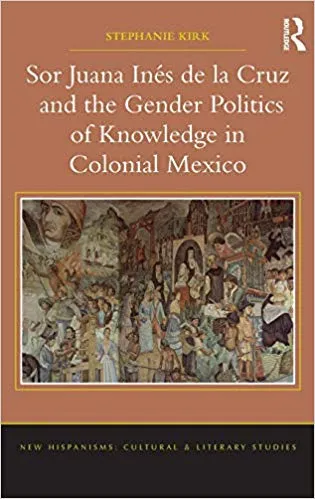
Sor Juana Inés de la Cruz and the Gender Politics of Knowledge in Colonial Mexico
By Stephanie Kirk
Each of the book's five chapters evokes a colonial Mexican cultural and intellectual sphere: the library, anatomy and medicine, spirituality, classical learning, and publishing and printing. Using an array of literary texts and historical documents and alongside secondary historical and critical materials, the author Stephanie Kirk demonstrates how Sor Juana used her poetry and other works to inscribe herself within the discourses associated with these cultural institutions and discursive spheres and thus challenge the male exclusivity of their precepts and precincts. Kirk illustrates how Sor Juana subverted the masculine character of erudition, writing herself into an all-male community of scholars. From there, Sor Juana clearly questions the gender politics at play in her exclusion, and undermines what seems to be the inextricable link previously forged between masculinity and institutional knowledge. Sor Juana Inés de la Cruz and the Gender Politics of Knowledge in Colonial Mexico opens up new readings of her texts through the lens of cultural and intellectual history and material culture in order to shed light on the production of knowledge in the seventeenth-century colonial Mexican society of which she was both a product and an anomaly.

